Inventory management is one of the most consequential operational processes for a growing business. Whether the business runs a retail shop, manages construction materials, operates a pharmacy, or repairs vehicles, knowing exactly what stock exists and where it sits directly affects efficiency and cash flow.
Poor inventory control leads to one of two problems: too much stock locking up cash, or too little stock delaying operations. FIFO, JIT, and ABC analysis are the three methods most businesses reach for to manage that balance. This covers each one with a worked example, so the choice is concrete rather than theoretical.
What These Methods Actually Solve
FIFO, JIT, and ABC analysis solve three different problems, not the same one. FIFO decides which units of stock get used or sold first. JIT decides how much stock to hold at all. ABC analysis decides where to focus counting and reorder attention across a catalog. A business can use one, two, or all three at once, because they answer different questions rather than competing approaches to the same question.
FIFO (First In, First Out)
FIFO assumes the oldest stock is sold or used first. It is the standard choice for anything perishable or subject to obsolescence, and the most common valuation method for small businesses generally because it mirrors how stock physically moves in most warehouses.
Worked example. A bakery buys flour in three batches: 50kg on March 1st at $0.80/kg, 50kg on March 10th at $0.85/kg, and 50kg on March 20th at $0.90/kg. Under FIFO, the first 50kg used in production is costed at $0.80/kg, the next 50kg at $0.85/kg, and so on. If the bakery uses 70kg before month end, the cost of goods used is (50 x $0.80) + (20 x $0.85) = $57.
Industry fit. Food, pharmacy, and chemical suppliers rely on FIFO almost by necessity, since older stock genuinely needs to move first to avoid spoilage or expiry. Retailers selling trend-sensitive goods also default to FIFO to avoid holding aging stock. For a full comparison against the alternative, including tax implications, see FIFO vs LIFO for small businesses.
Just In Time (JIT)
JIT inventory means ordering materials only when they are actually needed for the next step, rather than holding large buffer stock.
Worked example. A furniture workshop that builds to order might keep zero stock of a specific fabric and instead order the exact yardage needed the day a customer confirms a couch order, timed to arrive before cutting starts. Compare that to holding three months of every fabric on hand: JIT ties up far less cash, but it depends entirely on the fabric supplier delivering reliably and on schedule.
Industry fit. JIT fits well where demand is predictable enough to plan around, and where suppliers are reliable: manufacturing with stable order pipelines, made-to-order production, or retailers with tight supplier relationships. It fits poorly where lead times are unpredictable or where a stockout is costly, since JIT has no buffer to absorb a late delivery.
ABC Analysis
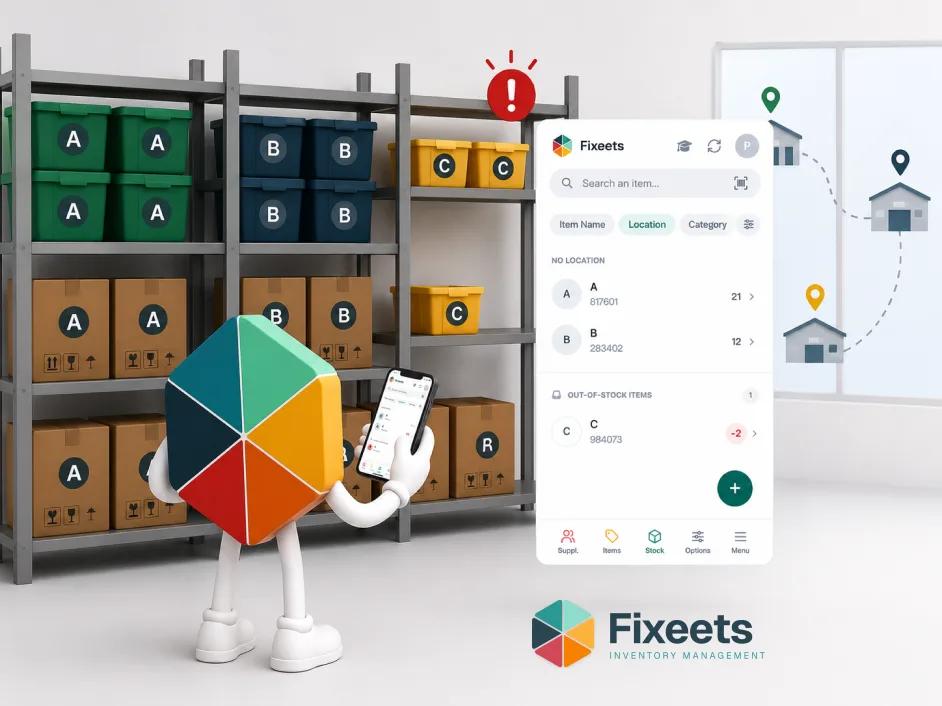
ABC analysis categorizes inventory by value contribution, not by physical characteristics.
| Category | Description | Typical share of SKUs | Typical share of value |
|---|---|---|---|
| A | High-value or fast-moving, close monitoring | Roughly 10-20% | Roughly 70-80% |
| B | Moderate value, moderate attention | Roughly 20-30% | Roughly 15-25% |
| C | Low value, high quantity, light monitoring | Roughly 50-60% | Roughly 5-10% |
Worked example. A hardware store carrying 500 SKUs might find that 80 SKUs (power tools, generators) account for most of its inventory value. Those 80 get weekly counts and tight reorder points. The remaining 420 SKUs (washers, screws, small fasteners) get monthly counts and looser thresholds, since a stockout there is cheap to fix and rarely urgent.
This is what makes ABC analysis practical rather than academic: it tells a small team where their limited counting time actually pays off. Our guide on ABC analysis for inventory walks through how to apply this classification step by step.
Applying All Three in Google Sheets
None of these methods require dedicated software to start. In a structured Google Sheet:
- For FIFO, log each stock receipt as its own row with date and unit cost in a Movements sheet, then calculate cost of goods used with a running allocation formula, or simply track quantity and rely on FIFO as the physical rotation rule if precise costing is not required.
- For ABC classification, add a column that ranks items by trailing revenue or usage, then bucket the top roughly 15% as A, the next roughly 25% as B, and the rest as C. Recalculate every quarter, since which items are "A" items shifts as demand changes.
- For JIT, the sheet's job shifts from tracking stock on hand to tracking supplier lead time and order triggers instead, since the goal is to hold as little buffer as workable.
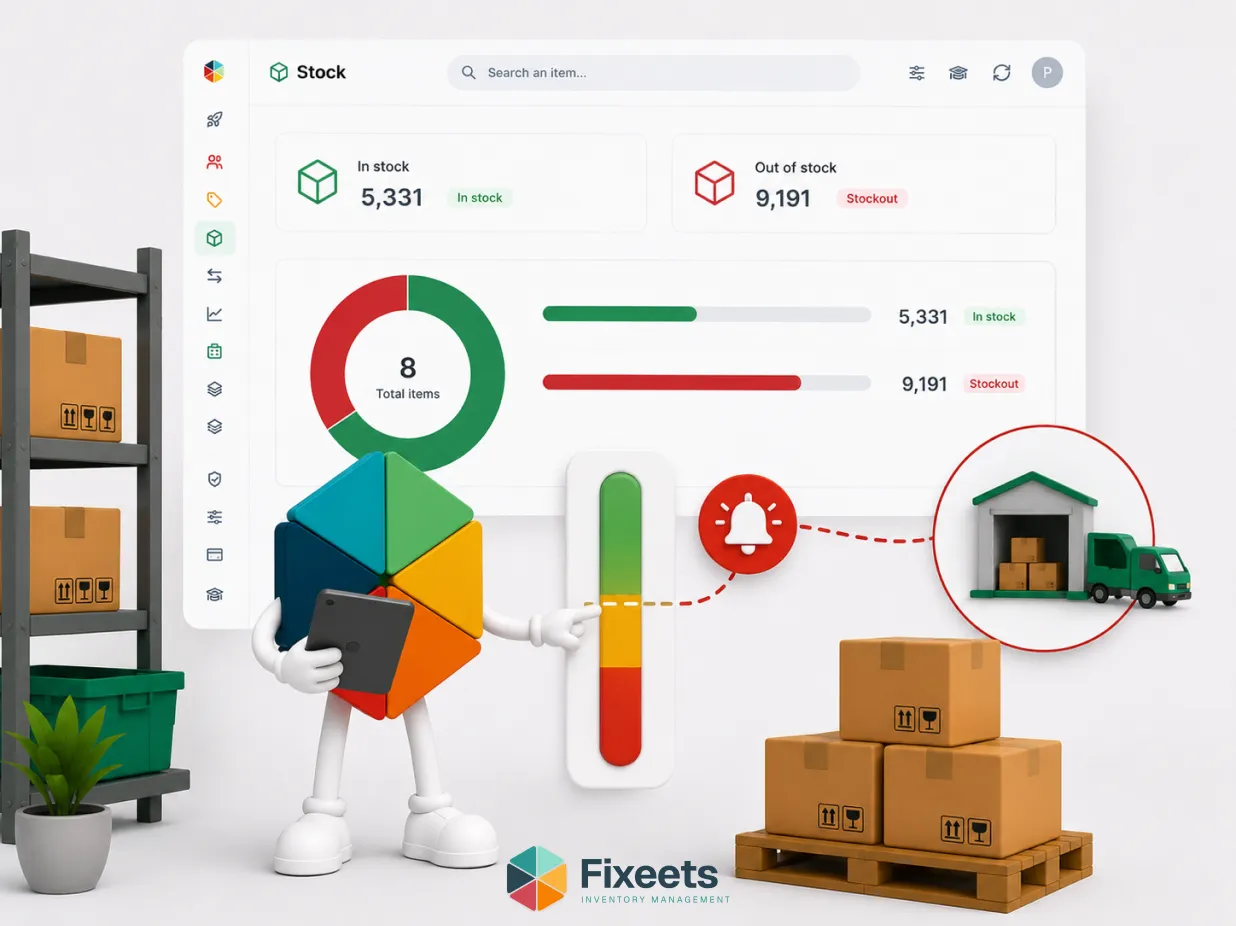
A structured add-on like Fixeets Inventory handles the movement logging and reorder alerting underneath all three, so the method chosen determines how thresholds are set, not how the underlying data gets tracked.
Inventory Management Across Industries
Retail businesses focus on turnover and tying stock levels to sales data, which is where inventory turnover ratio becomes a useful metric to track. Construction companies manage materials across multiple job sites, where a missing supply can delay an entire project, which is where multi-location inventory tracking matters most. Pharmacies require strict batch and expiry tracking for safety and regulatory reasons. Repair workshops maintain spare parts inventory so technicians are not waiting on supplier deliveries mid-job.
The methods differ in application, but the core objective is the same across every industry: reliable visibility into what a business owns and where it sits.
Where Fixeets Fits
Many small businesses start inventory tracking in Excel or Google Sheets, which is familiar and easy to deploy without training. The limits show up as volumes grow: no automatic reorder alerts, no barcode scanning, and formulas that break when someone edits the wrong cell. Fixeets Inventory Management extends Google Sheets with movement tracking, reorder alerts, and multi-location visibility, so a team can apply FIFO, ABC, or a JIT-style low-buffer approach using tools they already understand, without adopting a full ERP system. For a closer look at where a plain spreadsheet specifically breaks down, see how Fixeets compares to Excel for inventory management.
For a deeper treatment of everything covered here, including system selection and day-to-day operation, see our complete inventory management guide.
FAQ
What is the difference between FIFO and JIT?
FIFO decides which units of existing stock get used first. JIT decides how much stock to hold in the first place. A business can run FIFO rotation on a small JIT buffer at the same time, since they solve different problems.
Is ABC analysis only useful for large catalogs?
It becomes most useful once a catalog passes roughly fifty SKUs. Below that, the overhead of classifying items often outweighs the benefit, since a small team can reasonably watch every item closely anyway.
Can a small business use FIFO without dedicated software?
Yes. Logging each stock receipt with its date and cost in a movement log, and physically rotating older stock to the front, covers FIFO for most small operations without needing automated cost allocation.
Why does JIT work poorly for some businesses?
JIT depends on reliable, fast supplier delivery. If lead times are unpredictable or a stockout is costly (a missed sale, a delayed production run), JIT's lack of buffer stock turns a supplier delay directly into a business problem.
How often should ABC categories be recalculated?
Quarterly is a reasonable default for most small businesses. Demand shifts, seasonal items move between categories, and a classification left stale for a year stops reflecting which items actually matter most.
Do these methods require an ERP system to implement?
No. All three can be applied inside a structured Google Sheet with a proper movement log and a few classification formulas. An ERP adds automation and scale, but the underlying logic works the same in a spreadsheet.
Which method should a small business start with?
ABC analysis first, since it takes the least setup and immediately shows where counting effort is being wasted. FIFO or a JIT-style approach can then be layered in based on what the business actually sells, perishable versus made-to-order.