An inventory audit is the moment every small operation dreads. Someone eventually asks the question everyone has been avoiding: does the sheet actually match what's on the shelf? The usual answer is to shut everything down for a day, count everything by hand, and hope orders don't come in while the count is happening.
That approach works, but it costs a full day of operations and still only tells you the answer once.
What Is an Inventory Audit?
An inventory audit is the process of physically verifying that recorded stock quantities match actual stock on hand. It exists to catch the drift that accumulates between what a system says is in stock and what is actually there, caused by miscounts, unrecorded movements, damage, theft, or simple data entry errors.
A full audit checks every SKU at once. A cycle count checks a subset of SKUs on a rolling basis, so the entire inventory gets verified over time without ever requiring a single full stop.
Why Full Shutdown Audits Are Costly
A full physical count, where every SKU is checked in one sitting, is disruptive by design. Orders have to pause. Staff are pulled off their normal tasks. For a warehouse or retail operation, a full day of lost throughput is a real cost, not just an inconvenience.
Full audits are also higher risk in a different way: counting everything at once, under time pressure, increases the chance of counting errors. A count rushed to reopen the business by end of day is not necessarily a more accurate count than a slower, staged approach.
Cycle Counting: The Alternative to Full Shutdown
Cycle counting spreads the audit across smaller, regular counts rather than one large event. Instead of counting 2,000 SKUs in a single day, a team might count 50 to 100 SKUs per day, cycling through the full catalog over several weeks.
This approach has three practical advantages. It does not require stopping operations, since a small subset of SKUs can be counted without disrupting the rest of the warehouse or store. It surfaces discrepancies faster, since problems are caught within days rather than sitting undetected for a year. And it spreads the labor cost evenly rather than concentrating it into one disruptive event.
Prioritizing what to count first
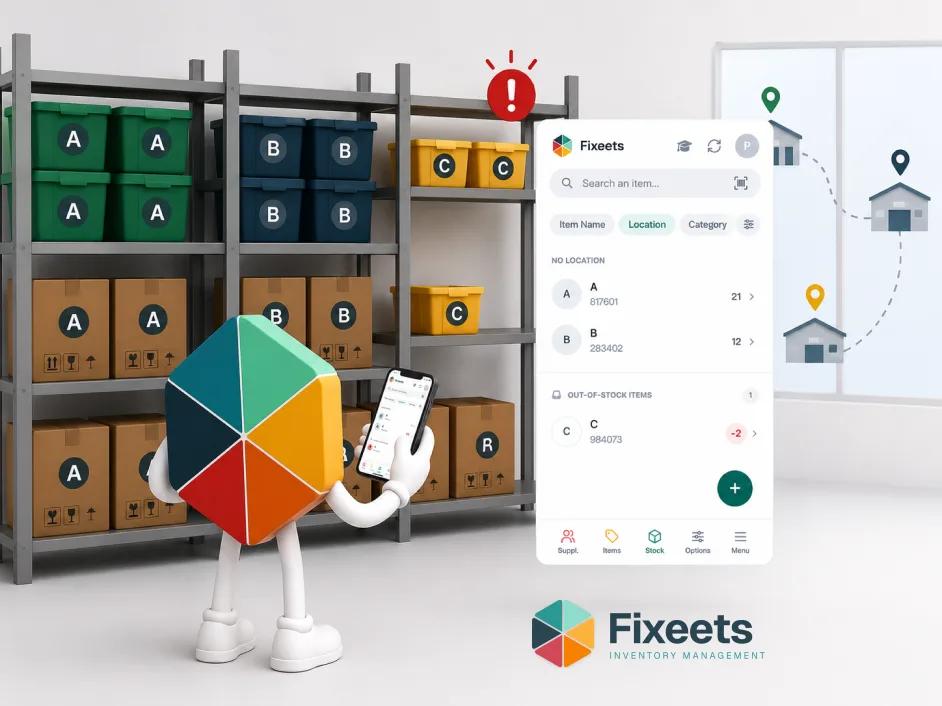
Not every SKU needs the same counting frequency. Applying ABC analysis to prioritize cycle counts makes the process more efficient: count your highest-value, fastest-moving A-class items most frequently, since errors there carry the most financial and operational risk. B-class items can be counted less often, and C-class items least often of all.
For a full breakdown of how to categorize stock this way, the article on ABC analysis for inventory covers how to apply it and what decisions each category should drive.
How to Run a Cycle Count Without Disrupting Operations
Count during natural lulls, not peak hours
Schedule counts for the parts of the day or week when order volume is naturally lower. This might be early morning before the first shipment goes out, or a specific weekday that historically sees less activity.
Freeze movement on the SKUs being counted, not the whole warehouse
Rather than halting all activity, restrict movement only on the specific SKUs scheduled for that count cycle. Other SKUs continue moving normally. This is the core mechanic that makes cycle counting non-disruptive: the freeze is narrow, not warehouse-wide.
Reconcile discrepancies immediately, not at the end of the month
When a count reveals a mismatch, investigate and correct it the same day if possible. Discrepancies that pile up unresolved for weeks become harder to trace back to their cause, since the trail of what happened to that SKU in the meantime has grown longer.
Keep a log of what was counted and when
A simple log, tracking which SKUs were counted, on what date, by whom, and what discrepancy (if any) was found, turns individual counts into a dataset. Over time, this reveals which SKUs or which parts of the warehouse have recurring accuracy problems, which is more useful than treating each count as an isolated event.
What Causes Inventory Discrepancies
Understanding common causes helps target where counting effort and process fixes should go:
Unrecorded movements. Stock moved, sold, or transferred without the corresponding record being updated at the same time.
Data entry errors. A quantity typed incorrectly, or a transaction applied to the wrong SKU.
Damage or shrinkage not logged. Stock damaged, expired, or lost that never gets formally removed from the recorded count.
Multi-location transfers. Stock physically moved between locations without both the sending and receiving location being updated, common in operations without consolidated multi-location visibility.
The article on how to manage inventory across multiple locations in Google Sheets covers how to structure tracking to reduce this specific source of discrepancy.
Running Inventory Audits Inside Fixeets
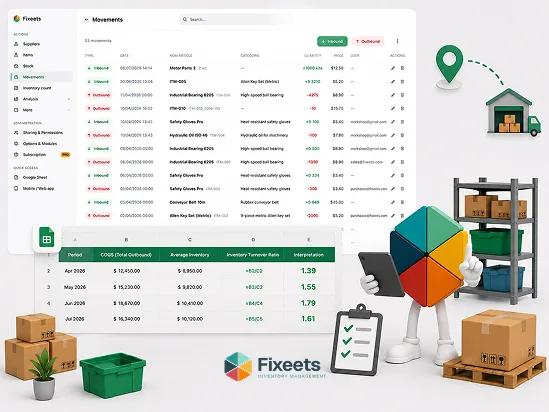
Fixeets tracks every stock movement at the SKU level, which gives a cycle counting process something to reconcile against directly: the recorded movement history for a given SKU, rather than just a single current quantity figure with no explanation of how it got there.
When a discrepancy is found during a count, having a movement log to check against makes it faster to identify whether the mismatch traces back to an unrecorded transfer, a data entry error, or something else. This turns reconciliation from guesswork into a more targeted investigation.
To see how stock movement tracking supports this kind of reconciliation, visit the Fixeets inventory management page.
Key Takeaways
- An inventory audit verifies that recorded stock quantities match what is actually on hand. Full shutdown audits are costly in lost operating time and can introduce their own counting errors under time pressure.
- Cycle counting spreads the audit across smaller, regular counts, so the full catalog gets verified over time without ever requiring a full stop.
- Prioritize cycle count frequency using ABC analysis: count high-value, fast-moving SKUs most often.
- Non-disruptive counting works by freezing movement only on the specific SKUs being counted, scheduling counts during natural lulls, and reconciling discrepancies the same day they're found.
- Common causes of discrepancies include unrecorded movements, data entry errors, unlogged damage or shrinkage, and multi-location transfers that update one location but not the other.
- A movement log, rather than just a current quantity figure, makes reconciling a discrepancy a targeted investigation instead of a guess.
Frequently Asked Questions
What is an inventory audit? An inventory audit is the process of physically verifying that recorded stock quantities match actual stock on hand. It identifies drift caused by miscounts, unrecorded movements, damage, theft, or data entry errors.
What is cycle counting? Cycle counting is an approach to inventory auditing where a subset of SKUs is counted on a rolling schedule, rather than counting the entire inventory in one sitting. Over time, the full catalog gets verified without requiring a single full stop of operations.
How often should I do a full inventory count versus cycle counts? Many operations move to cycle counting exclusively, verifying the full catalog through rolling counts rather than doing one disruptive annual count. Cycle counting frequency should be higher for high-value or fast-moving SKUs and lower for slow-moving, low-value items.
How do I count inventory without stopping operations? Freeze movement only on the specific SKUs scheduled for that count cycle, rather than the entire warehouse. Schedule counts during natural lulls in order volume. This keeps the rest of the operation running normally while the count happens.
What causes inventory discrepancies? Common causes include unrecorded stock movements, data entry errors, unlogged damage or shrinkage, and multi-location transfers where one location is updated but the other is not.
How do I decide which SKUs to count first in a cycle count? Apply ABC analysis to prioritize. Count your highest-value, fastest-moving SKUs most frequently, since discrepancies there carry the greatest financial and operational impact. Lower-value, slower-moving SKUs can be counted less often.
What should I do when a cycle count finds a discrepancy? Investigate and correct it as close to the same day as possible. The longer a discrepancy sits unresolved, the harder it becomes to trace back to its actual cause.
Does cycle counting take more total time than a full audit? Total counting time is similar, but cycle counting spreads it across many small sessions rather than one large disruptive event, which avoids the operational cost of a full shutdown and tends to produce more accurate individual counts since staff are not rushing under time pressure.
How does Fixeets help with inventory audits? Fixeets logs every stock movement at the SKU level. During a cycle count, this movement history gives you something concrete to reconcile a discrepancy against, rather than just a current quantity figure with no record of how it was reached.
Is cycle counting suitable for a small business with limited staff? Yes. Cycle counting is often more practical for small teams than a full audit, since it can be done in small increments alongside normal daily work rather than requiring a dedicated block of staff time to shut down and count everything at once.