Maintenance management KPIs are measurable metrics that show how effectively an operation maintains its equipment, responds to failures, and prevents unplanned disruptions. For operations managers in small and mid-size teams, these indicators turn maintenance from a cost centre into a visible, improvable part of the business.
Most small operations track whether equipment is working or not. Very few measure the performance of their maintenance function itself. That gap is where KPIs come in. They answer questions like: are we getting faster at resolving issues? Are our preventive efforts reducing breakdowns? Where should the next maintenance investment go?
Why Maintenance KPIs Matter for Small Operations
In larger organisations, maintenance departments have dedicated analysts and dashboards. Small operations rarely have that luxury. The assumption is often that KPIs are for companies with dozens of assets and a full maintenance team.
That assumption is worth challenging.
Small operations have tighter margins. Every hour of unplanned downtime, every emergency repair, every delayed work order has a proportionally larger impact. KPIs do not need to be complex to be useful. Even two or three consistently tracked metrics can shift how maintenance decisions get made.
The value is in pattern recognition. Without KPIs, every breakdown feels isolated. With them, recurring problems become visible. Assets that consume disproportionate repair budgets stand out. Preventive maintenance intervals that are too frequent or too infrequent become obvious.
A practical starting point for building the maintenance system that generates this data is available in Maintenance Management for Small Businesses: A Practical Guide.
The KPIs That Matter Most for Small Teams
Not every maintenance KPI is relevant at every scale. Large facilities track dozens of metrics. For small operations, focusing on the right five or six creates the most value with the least overhead.
1. Equipment Downtime
What it measures: The total time an asset is out of service due to failure or repair, typically measured in hours per month or per quarter.
Why it matters: Downtime is the most direct measure of maintenance impact on operations. Tracking it per asset reveals which equipment is causing the most disruption and whether the situation is improving or getting worse over time.
How to track it: Record the start time and end time of every unplanned stoppage. The difference is your downtime duration. Sum these across a period for total downtime per asset.
A deeper look at what downtime costs and how to reduce it is available in How to Reduce Unplanned Downtime in Small Operations.
2. Mean Time Between Failures (MTBF)
What it measures: The average operating time between two consecutive failures for the same asset.
Why it matters: MTBF shows equipment reliability. A rising MTBF means the asset is running longer between breakdowns, which suggests maintenance is working. A declining MTBF signals that something is wearing out faster than current maintenance is addressing.
How to calculate it: Take the total operating time in a period and divide by the number of failures in that period. If a machine operated for 720 hours in a month and failed twice, the MTBF is 360 hours.
3. Mean Time to Repair (MTTR)
What it measures: The average time it takes to restore an asset to working condition after a failure.
Why it matters: MTTR reflects the efficiency of the repair process. A high MTTR could mean parts are hard to source, technicians lack information about the asset, or diagnostic steps are unclear. Reducing MTTR directly reduces the operational impact of every failure.
How to calculate it: Sum the total repair time across all failures in a period and divide by the number of failures. If three failures took 2, 4, and 6 hours to repair, the MTTR is 4 hours.
4. Planned Maintenance Percentage (PMP)
What it measures: The proportion of total maintenance hours spent on planned or preventive tasks versus reactive or emergency tasks.
Why it matters: This is the clearest indicator of whether an operation is reactive or preventive. A PMP below 30% means the team spends most of its maintenance effort responding to breakdowns. A PMP above 60% indicates a mature preventive approach. The goal is to increase PMP over time.
How to calculate it: Divide the number of planned maintenance hours by the total maintenance hours (planned plus unplanned) and multiply by 100.
Understanding the difference between planned and unplanned maintenance is fundamental to this metric. CMMS on Google Sheets: Maintenance Tracking for Small Teams covers both maintenance types and how to structure them.
5. Work Order Completion Rate
What it measures: The percentage of work orders that are completed within their scheduled timeframe.
Why it matters: A high completion rate means the maintenance schedule is realistic and the team is executing consistently. A low completion rate can indicate that too many tasks are scheduled, resources are insufficient, or priorities are unclear. Either way, it signals where the process needs adjustment.
How to calculate it: Divide the number of work orders completed on time by the total number of work orders issued in a period.
6. Maintenance Cost per Asset
What it measures: The total maintenance spend on a specific asset over a given period, including parts, labour, and any external service costs.
Why it matters: This metric identifies which assets are consuming the most maintenance budget. It also supports replacement decisions. When the annual maintenance cost of an asset approaches or exceeds its replacement cost, the financial case for replacing it becomes clear.
How to track it: Assign every maintenance expense to a specific asset. Sum these at the end of each quarter or year.
How to Start Tracking KPIs Without Overcomplicating It
The biggest barrier to KPI tracking in small operations is not the math. It is data collection. KPIs are only useful if the underlying data is consistent and reliable.
Start with the maintenance log
Every KPI listed above depends on recorded maintenance events. Start and end times. Task type. Asset involved. Cost of parts and labour. Whether the task was planned or reactive.
A structured maintenance log captures all of this. If a log is already in place, the KPI calculations are straightforward. If it is not, building one is the first step. Preventive Maintenance Checklist: Stop Equipment Failures includes guidance on structuring both the schedule and the log, and building a maintenance history log covers the patterns a well-kept log reveals beyond the KPIs themselves.
Pick two or three KPIs to start
Tracking all six KPIs from day one creates overhead that teams often abandon within a month. A better approach is to start with the two or three that are most relevant to your current situation.
If unplanned downtime is the primary concern, start with Equipment Downtime and MTBF. These two together show how often things fail and how long the impact lasts.
If the maintenance function feels disorganised, start with Planned Maintenance Percentage and Work Order Completion Rate. These show whether the team is working proactively and finishing what it starts.
Review monthly, not daily
KPIs for small operations are most useful as monthly or quarterly trends. Daily tracking creates noise. Monthly reviews create patterns. The goal is to see directional movement over time, not to react to individual data points.
Connecting KPIs to Maintenance Decisions
KPIs are only useful if they lead to action. Here is how each metric connects to a concrete decision.
High downtime on a specific asset suggests the preventive maintenance interval for that asset is too long, or the scope of the preventive tasks is insufficient. Adjust the schedule.
Declining MTBF on an asset that receives regular maintenance indicates a deeper issue. The asset may be approaching end of life, or the maintenance tasks may not be addressing the actual failure mode.
High MTTR suggests the repair process needs improvement. Common fixes include pre-staging spare parts, improving documentation on asset history, or ensuring the right tools are available before the technician arrives.
Low PMP means the team is mostly firefighting. The priority is to increase the share of planned work by building and following a preventive schedule. Even a small shift, from 20% to 40% planned, changes the operational rhythm.
Low work order completion rate means the schedule is unrealistic or resources are stretched. Either reduce the number of scheduled tasks or add capacity. Completing fewer tasks consistently is better than scheduling many and finishing half.
High maintenance cost on a single asset triggers a repair-versus-replace analysis. If the cost trend is rising, replacement is likely more economical than continued repair.
What a CMMS Does With KPIs
A CMMS, or Computerised Maintenance Management System, automates much of the data collection that makes KPI tracking possible. Work orders, downtime events, and maintenance costs are captured as part of the workflow rather than requiring manual entry.
For operations that have outgrown manual tracking, a CMMS provides the structure and reporting to make KPIs a natural output of daily operations rather than a separate exercise.
An overview of what a CMMS offers and when it makes sense for small teams is available in What Is a CMMS and Do Small Businesses Actually Need One?.
How Fixeets Supports Maintenance KPI Tracking
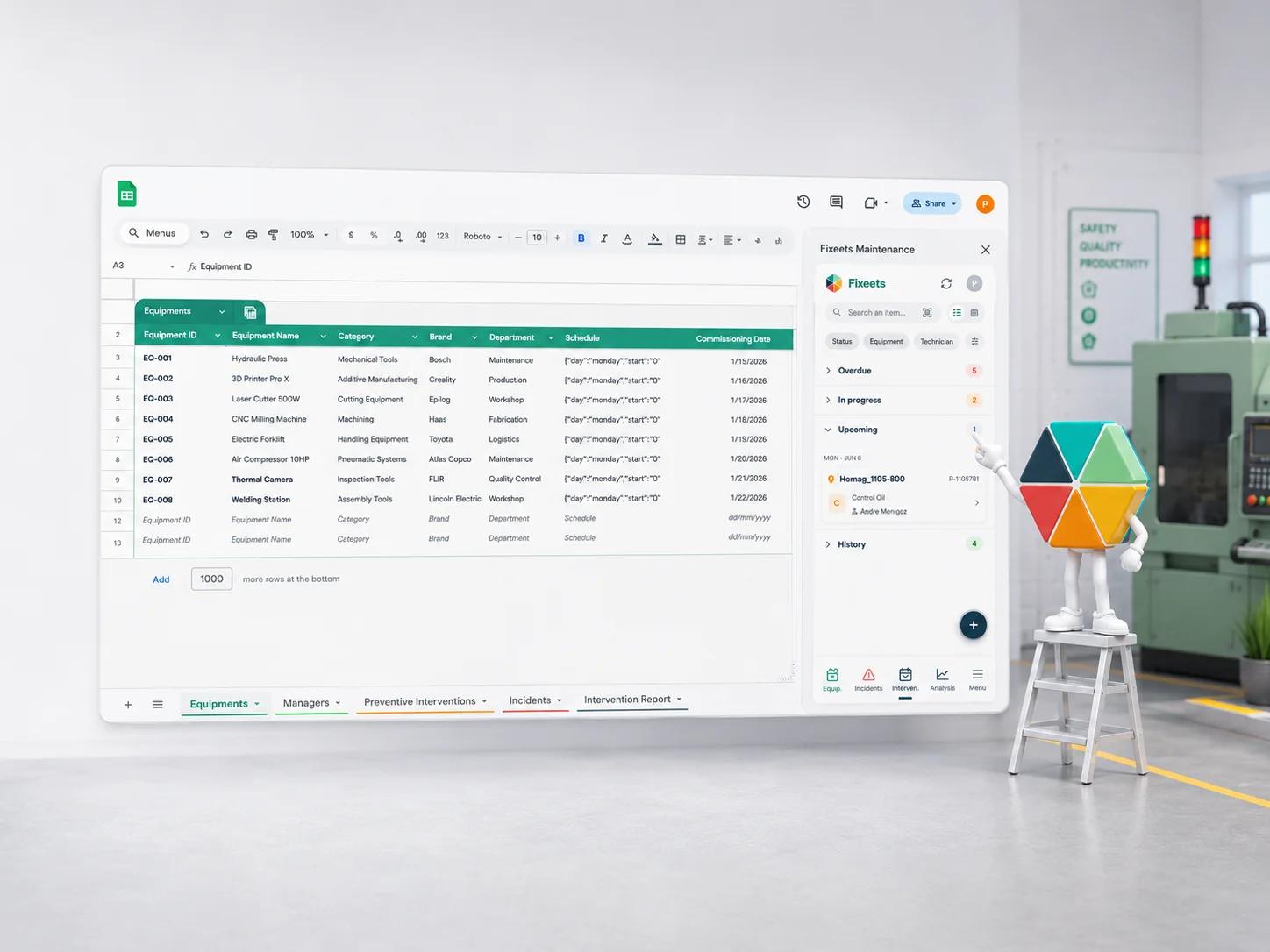
Fixeets includes a Maintenance Management module built inside Google Sheets and Google Workspace. It provides structured work orders, preventive maintenance scheduling, and a maintenance log that captures the data needed for KPI tracking.
Because every completed work order and logged intervention is structured and timestamped, the raw data for metrics like downtime, MTBF, PMP, and completion rate accumulates as part of normal operations. Teams do not need to maintain a separate tracking system.
For operations ready to start measuring maintenance performance, the full feature set is on the Fixeets maintenance management page.
KPIs are one chapter of a larger discipline. Our complete guide to maintenance management covers the foundations they measure, from preventive scheduling to intervention history.
Key Takeaways
- Maintenance KPIs help small operations move from reactive decision-making to informed, data-driven maintenance management
- The six most relevant KPIs for small teams are equipment downtime, MTBF, MTTR, planned maintenance percentage, work order completion rate, and maintenance cost per asset
- Every KPI depends on consistent data from a structured maintenance log. Building the log is the prerequisite
- Start with two or three KPIs that match your current operational priorities rather than trying to track everything at once
- Review KPIs monthly or quarterly. The value is in trends and patterns, not individual data points
- Each KPI connects to a specific maintenance decision: adjusting schedules, improving repair processes, rebalancing workloads, or evaluating asset replacement
- The goal is not perfect measurement. It is enough visibility to make better maintenance decisions over time
Frequently Asked Questions
What are maintenance management KPIs? Maintenance management KPIs are measurable metrics that evaluate how effectively an operation maintains its equipment. Common examples include equipment downtime, mean time between failures, mean time to repair, and planned maintenance percentage.
Which maintenance KPIs should small teams track first? Start with equipment downtime and mean time between failures if unplanned breakdowns are the main concern. Start with planned maintenance percentage and work order completion rate if the priority is improving maintenance organisation.
What is Mean Time Between Failures (MTBF)? MTBF is the average operating time between two consecutive failures for the same asset. It measures equipment reliability. Higher MTBF means the asset runs longer between breakdowns.
What is Mean Time to Repair (MTTR)? MTTR is the average time it takes to restore an asset to working condition after a failure. Lower MTTR means faster recovery from breakdowns and less operational disruption.
What is Planned Maintenance Percentage? Planned Maintenance Percentage measures the share of total maintenance hours spent on scheduled or preventive tasks versus reactive or emergency work. A higher percentage indicates a more proactive maintenance operation.
How do I calculate maintenance cost per asset? Assign every maintenance expense, including parts, labour, and external services, to the specific asset it was spent on. Sum these over a quarter or year to see the total maintenance investment per asset.
Do I need software to track maintenance KPIs? A structured maintenance log in Google Sheets can support KPI tracking for most small operations. Software like a CMMS adds automation and reporting, which becomes valuable as asset count and team size grow.
How often should I review maintenance KPIs? Monthly or quarterly reviews work best for small operations. Daily tracking creates noise without actionable patterns. Monthly reviews reveal trends that inform scheduling, budgeting, and asset decisions.
What is a good Planned Maintenance Percentage for a small operation? Industry benchmarks suggest 60% or above indicates a mature preventive maintenance approach. Most small operations starting from a reactive baseline should aim to reach 40% within the first six months of structured maintenance tracking.
How do maintenance KPIs help with budgeting? KPIs like maintenance cost per asset and equipment downtime show where maintenance spend is concentrated. This data supports budget allocation, justifies preventive maintenance investment, and identifies assets where replacement is more cost-effective than continued repair.
Can Google Sheets handle maintenance KPI calculations? Yes. With a structured maintenance log capturing task type, duration, cost, and asset information, Google Sheets formulas can calculate all of the KPIs listed in this article. Tools like Fixeets add structure to the log so the data is consistent and the calculations are reliable.
What is the relationship between MTBF, MTTR, and equipment availability? Equipment availability is calculated as MTBF divided by (MTBF plus MTTR). Higher MTBF and lower MTTR both increase availability. Tracking all three together gives a complete picture of asset performance.