Most operations teams log maintenance because someone told them to. Compliance, habit, or a manager who asked for it once. Very few teams treat the log itself as a decision-making asset. That is where the real value gets left on the table.
A maintenance history log is not just a record of what happened. Read correctly, it tells you what is about to happen, what is costing you the most, and which decisions were actually right.
What Is a Maintenance History Log?
A maintenance history log is a chronological record of every maintenance intervention performed on an asset: what was done, when, by whom, what was found, and what parts or time it consumed. Unlike a maintenance schedule, which defines what should happen, the history log records what actually happened.
Over time, this record becomes more than documentation. It becomes the dataset that reveals patterns no single intervention can show on its own.
Why a Single Log Entry Tells You Almost Nothing
One maintenance entry is a data point. It tells you a technician replaced a filter on a Tuesday. That alone is not useful for decisions.
The value appears when entries accumulate. Ten entries on the same asset over a year tell you how often it actually needs attention, whether the frequency is increasing, and whether the same fault keeps recurring. This is the shift most teams miss: the log is not valuable because you can look something up. It is valuable because it becomes a pattern once there is enough of it.
Teams that treat maintenance logging as a compliance chore rarely use it this way. They log, then move on. The information sits there unread until someone needs to defend a decision after the fact, rather than make a better one beforehand.
What Patterns a Maintenance History Log Reveals
Recurring Failures
If the same asset shows the same fault three times in six months, that is not bad luck. That is a signal the root cause has not been addressed, only the symptom. A single repair record would never show this. A history log, reviewed periodically, makes it obvious.
True Maintenance Cost Per Asset
Every intervention has a cost, whether it is tracked explicitly or not: parts, labor hours, and downtime. A history log lets you add these up per asset over time. This often reveals that a piece of equipment costing very little to purchase is quietly consuming more maintenance hours than a more expensive asset that rarely breaks down.
This is the kind of insight that changes replace-versus-repair decisions. Without historical data, that decision defaults to instinct.
Whether Preventive Maintenance Is Actually Working
A preventive maintenance schedule is a plan. The history log is the evidence of whether the plan is reducing failures. If scheduled preventive tasks are being completed on time but unplanned corrective interventions are not decreasing, the schedule itself may need adjustment, not just better adherence.
Comparing the ratio of preventive to corrective interventions over time, drawn directly from the log, is one of the clearest signals of whether a maintenance program is actually working.
Technician and Task Patterns
Over a large enough log, patterns emerge around which tasks take longer than expected, which technicians handle which types of interventions most efficiently, and where training gaps might exist. This is not about assigning blame. It is about understanding where time and expertise are actually being spent.
Seasonal or Usage-Based Trends
Some equipment fails more in certain seasons, after certain production runs, or once usage crosses a threshold. This kind of trend is invisible in any single record and only becomes visible once enough history accumulates and someone looks at it as a set rather than as isolated events.
Why This Matters More Than the Schedule Itself
A maintenance schedule tells you what should happen. It does not tell you if it is working. Teams often invest significant effort building a well-structured preventive maintenance schedule and then stop there, assuming the plan itself is the outcome.
The history log is what closes the loop. It is the only source of evidence for whether the schedule is actually reducing downtime, catching problems early, and justifying its own cost in labor and parts. Without it, a maintenance program runs on assumption rather than evidence.
If you have already built a schedule and want to connect it to a system for tracking what actually happens, the article on how to build a preventive maintenance schedule in Google Sheets covers the planning side of the setup.
What a Useful History Log Needs to Capture
Not every field matters equally. For the log to support real analysis later, it needs a consistent minimum:
- Asset ID, so every entry ties back to a specific piece of equipment unambiguously
- Date of intervention, not the date it was scheduled
- Type: preventive or corrective. This single field is what makes the preventive-to-corrective ratio possible to calculate
- Task performed, described specifically enough to spot recurring issues, not just "serviced"
- Findings, what the technician actually observed. This is often the most valuable and most frequently skipped field
- Parts used, to build an accurate cost picture over time
- Duration, to understand labor cost and capacity over time
Consistency matters more than completeness. A log with five fields filled in the same way every time is more useful than a log with fifteen fields filled inconsistently.
For a full breakdown of how to structure this in Google Sheets, the article on how to track equipment maintenance in Google Sheets covers the field-level setup and sheet structure in detail.
Turning History Into Decisions
Having the data is only half the value. The other half is reviewing it on a schedule, not just when something goes wrong.
A practical starting point: once a quarter, filter the log by asset and look for any equipment with three or more interventions in the period. That short list is where recurring problems, replace-versus-repair decisions, and root-cause investigations should focus. This turns a passive record into an active input for planning.
Why This Is Difficult in a Raw Spreadsheet
A well-maintained Google Sheets log can support this kind of analysis, but two things typically get in the way over time.
Entries are inconsistent. Without structure enforced at the point of entry, free-text fields drift. "Preventive" and "PM" and "planned" all mean the same thing but cannot be filtered together reliably.
The log depends on someone remembering to fill it in. If completing a work order and logging the intervention are two separate manual steps, the second step gets skipped under time pressure. Gaps accumulate quietly, and by the time someone tries to analyze the data, the history has holes that undermine the patterns it should reveal.
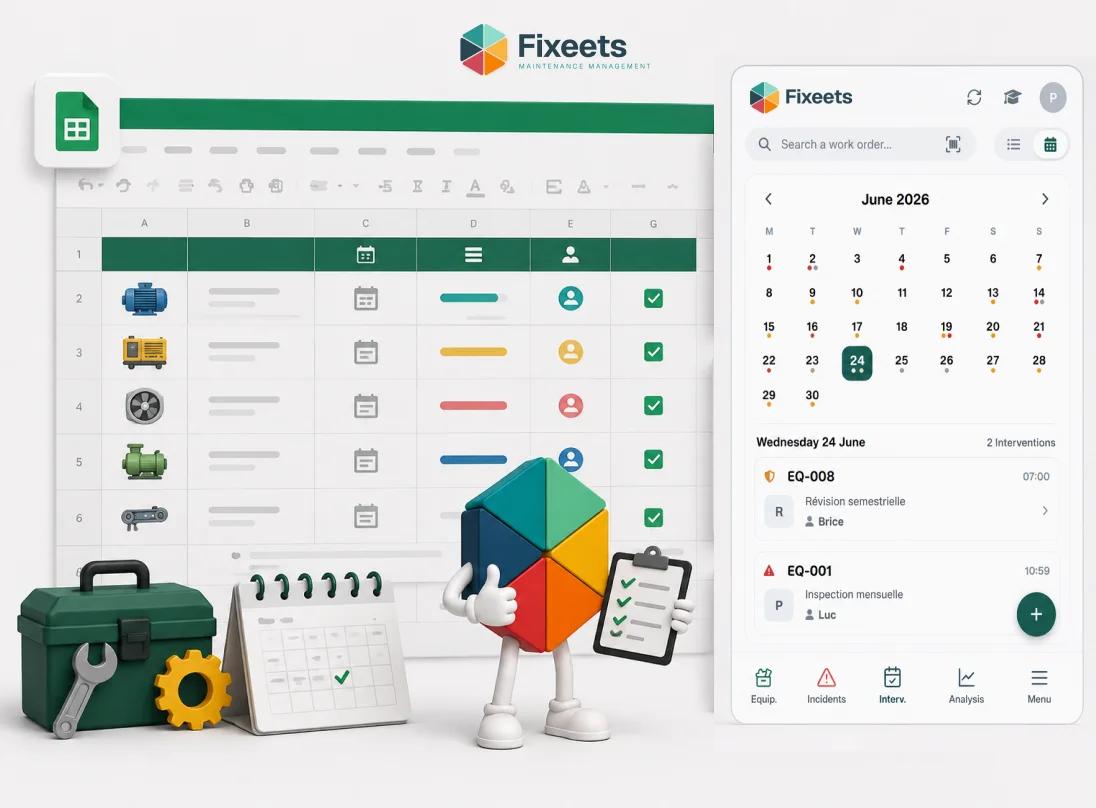
Fixeets closes this gap by logging every completed work order automatically. When a technician closes a task, the intervention is recorded in the maintenance history without a separate manual entry step. Over time, this produces a complete, consistent dataset without depending on someone remembering to keep it that way.
To see how work orders and history logging connect inside Fixeets, visit the Fixeets maintenance management page.
Building the log is one part of a broader practice. Our complete guide to maintenance management covers the rest, from choosing a CMMS to the KPIs the log feeds.
Key Takeaways
- A maintenance history log is only weakly useful as a single entry. Its real value comes from patterns visible once entries accumulate over time.
- A history log reveals recurring failures, true cost per asset, whether preventive maintenance is actually reducing corrective work, technician and task patterns, and seasonal trends.
- A maintenance schedule defines what should happen. The history log is the only evidence of whether it worked.
- Consistency in what gets logged matters more than the number of fields tracked. Asset ID, date, type, task, findings, parts, and duration are the practical minimum.
- Review the log on a regular cycle, not just reactively. Quarterly reviews focused on assets with repeated interventions turn the log into a planning input.
- Raw spreadsheet logs break down when entries are inconsistent or when logging depends on a separate manual step that gets skipped under pressure.
Frequently Asked Questions
What is a maintenance history log? A maintenance history log is a chronological record of every maintenance intervention performed on an asset, including what was done, when, by whom, what was found, and what parts or time were used. It records what actually happened, as distinct from a maintenance schedule, which defines what should happen.
Why does a maintenance history log matter? A single log entry has limited value on its own. Once entries accumulate, the log reveals patterns: recurring failures, true maintenance cost per asset, whether preventive maintenance is reducing unplanned repairs, and seasonal or usage-based failure trends. These patterns inform decisions that no individual repair record can support.
What is the difference between a maintenance schedule and a maintenance history log? A schedule is a plan defining what maintenance should happen and when. A history log is the record of what actually happened. The schedule sets expectations; the log provides the evidence of whether those expectations were met and whether the plan is working.
How often should I review a maintenance history log? A quarterly review is a practical starting point. Filter by asset and look for any equipment with three or more interventions in the period. This short list is where recurring problems and replace-versus-repair decisions should be investigated first.
What fields should a maintenance history log include? At minimum: asset ID, date of intervention, maintenance type (preventive or corrective), task performed, findings, parts used, and duration. Consistency in how these are filled in matters more than tracking additional fields inconsistently.
How can I tell if my preventive maintenance program is actually working? Compare the ratio of preventive to corrective interventions in your history log over time. If corrective interventions are not decreasing despite preventive tasks being completed on schedule, the preventive plan itself likely needs adjustment, not just better adherence to it.
Why does a spreadsheet-based maintenance log often fail over time? Two common reasons: inconsistent entries from free-text fields that drift over time, and logging that depends on a separate manual step after completing the work, which gets skipped under time pressure. Both result in a log with gaps that undermine the patterns it should reveal.
Does Fixeets build a maintenance history log automatically? Yes. When a technician closes a work order in Fixeets, the intervention is recorded in the maintenance history log automatically, without a separate manual entry step. This produces a consistent dataset over time without depending on someone remembering to log it separately.
Can a maintenance history log help decide whether to replace or repair equipment? Yes. Adding up the true maintenance cost per asset over time, including parts, labor, and downtime, often reveals that a low-cost asset is consuming more maintenance resources than a more expensive one that rarely fails. This is difficult to see without historical data and easy to miss when decisions are made on instinct alone.
What is the most commonly skipped field in a maintenance log, and why does it matter? Findings, the technician's observations during the intervention, is frequently left blank or filled in with minimal detail. It is often the most valuable field because it can surface early warning signs of wear or failure before they become a breakdown, but it requires a habit of writing more than a one-word note.