FEFO (First Expired, First Out) is a picking rule: when the same item sits in stock in several batches, the batch with the nearest expiration date goes out first, whatever order the batches arrived in. Most of the time the oldest batch is also the one that expires first, so FEFO and FIFO give the same answer. The day they don't is the day a supplier delivers a newer case with a shorter date, the team picks from the front out of habit, and a full case expires at the back of the shelf.
What FEFO Means and How It Differs From FIFO
FIFO (First In, First Out) looks at the receiving date: what came in first goes out first. FEFO looks at the expiration date printed on the batch: what expires first goes out first. For goods that never expire, FIFO is enough. For goods that do, the expiration date is what decides whether stock can still be sold or used, so that is the date to follow.
The two rules split when receiving order and expiration order don't match. It happens more often than people expect: a distributor ships from an older pallet, a second supplier has a shorter shelf life, or a customer return comes back into stock with its original date.
Here is a simple case. On November 2, 2026, a small food distributor has four batches of the same oat milk, 32 oz cartons, in its warehouse:
| Batch | Received | Expiration date | Days left | Quantity |
|---|---|---|---|---|
| L-2408 | 08/20/2026 | 01/15/2027 | 74 | 24 |
| L-2411 | 09/05/2026 | 12/10/2026 | 38 | 36 |
| L-2415 | 10/01/2026 | 02/28/2027 | 118 | 48 |
| L-2419 | 10/22/2026 | 03/15/2027 | 133 | 60 |
Under FIFO, the next order of 30 cartons is picked from L-2408, the first batch received. Under FEFO, it comes from L-2411, which arrived two weeks later but expires five weeks earlier. If the team keeps taking L-2408 first, L-2411 waits behind it, and part of its 36 cartons may reach their date before anyone gets to them.
A word on vocabulary. FIFO is also an accounting method that sets the cost of what you sell, explained in our FIFO vs LIFO guide. FEFO is not a costing method. It is about the physical gesture in the stockroom: which case goes in the cart.
When FEFO Matters: Food, Pharmacy, Cosmetics, Chemicals and Parts
FEFO is worth the effort as soon as a product carries a date that limits its use. The usual cases:
- Food and beverages: fresh and chilled goods, but also dry goods, drinks and ingredients with a best-by date
- Pharmacy and medical supplies: medicines, test kits, sterile consumables
- Cosmetics and personal care: products with an expiration date or a period after opening
- Chemicals and lab supplies: reagents, adhesives, paints, sealants, cleaning products
- Parts with a shelf life: batteries, rubber seals and O-rings, glues, lubricants
Not every date means the same thing. Some mark quality, like "best if used by", and some mark safety, like "use by" on perishable food. The rules depend on the product and the sector, so check what applies to yours. In the stockroom the logic stays the same: the date your team has to respect is the one that orders the shelf.
FEFO matters less when shelf life is long compared with how fast the stock turns. If a product keeps for two years and the shelf empties every month, FIFO and FEFO will almost always pick the same batch.
What to Record at Receiving: Batch Number and Expiration Date
FEFO only works if the date is known before the picker is standing in front of the shelf. That means writing it down when the goods arrive, not hunting for it on the carton later.
For each delivery line, note:
- The item, as it is named in your stock list
- The batch number printed by the manufacturer or supplier (also called lot number or batch code)
- The expiration date of that batch
- The quantity received
- Where it is stored, if you have more than one location
Two deliveries of the same item with different dates are two batches, even if they end up on the same shelf. Keep them on separate lines. If one delivery contains several batches, split it into several lines at receiving. It takes a minute at the dock and saves a lot of guessing afterwards.
The batch number is not only there for FEFO. If a supplier recalls a batch, it is how you find out whether you received it, how much is left and where the rest went. Without it, a recall means checking every carton by hand.
Setting Up the Shelf and the Picking Rule
Once the dates are recorded, the shelf has to make the right batch the easy one to grab.
- Put the nearest date in front, on the pick face, and newer dates behind or above. When a delivery arrives with a shorter date than what is already there, it goes in front, not behind.
- Mark the date where it can be read without opening the case. A large handwritten date on the side of the box is enough.
- Write the rule in one sentence, for example: "Always pick the batch with the nearest expiration date. If two batches have the same date, take the one received first." The second half is FIFO, used as a tiebreaker.
- Decide what happens close to the date. A batch inside your limit might go to a discount, to internal use or back to the supplier, depending on your business. Decide it once, not case by case at the shelf.
- Record the batch on every exit. When each exit line says which batch left, the stock per batch stays right, and the next person sees what is really left on each date.
The last point is where most spreadsheet setups break. Exits get recorded per item, not per batch, so the total is right but nobody knows which dates are still on the shelf.
A Weekly Look at What Expires Soon
Even with a well-organized shelf, some batches slip: a slow month, a cancelled order, a case pushed to the back. A short weekly review catches them while there is still time to act.
Once a week, list every batch still in stock, sorted by expiration date, with the days left. Then split the list into three groups:
- Expired: take it out of sellable stock and record the exit, so the count stays right
- Expiring soon: decide now, whether that means pushing it in sales, using it first in production, discounting it or asking the supplier about a return
- Everything else: nothing to do this week
Look at value as well as quantity. Ten cartons of a cheap item and ten boxes of an expensive reagent are not the same problem.
Expired stock that gets thrown away is also stock you no longer have. If it was still counted as available, the next order can come up short. The weekly review protects you on both sides, less waste and fewer surprises, and it fits with how you set reorder points, covered in what a stockout is and how to prevent it.
FEFO in Google Sheets With Fixeets Inventory
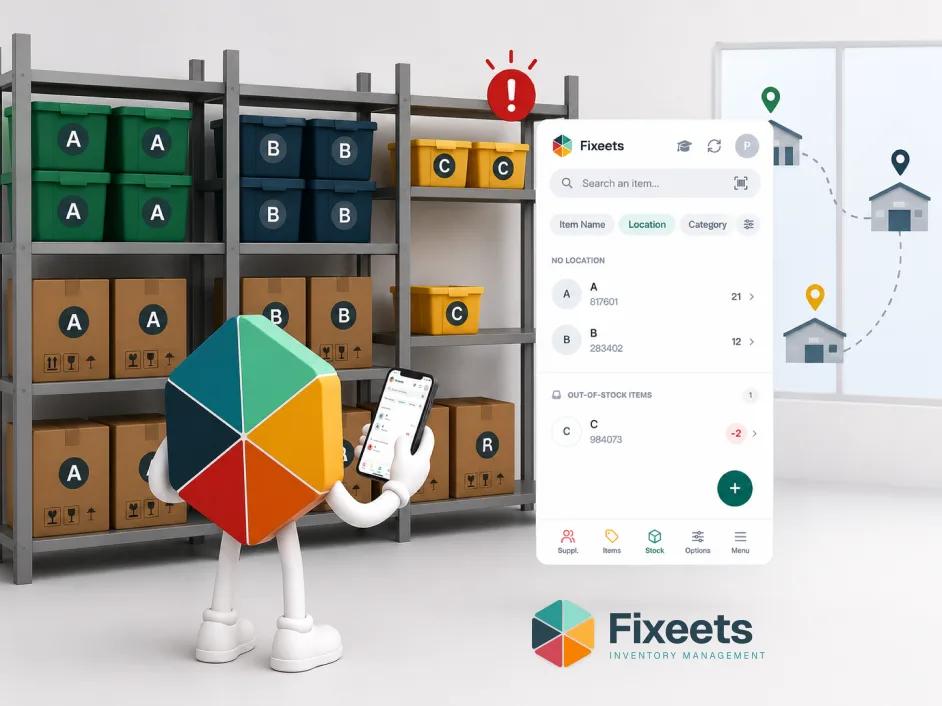
You can run FEFO in a plain spreadsheet with one row per batch. It holds as long as everyone records the batch on every exit and someone sorts the list by date every week. Fixeets Inventory, our inventory management app for Google Sheets, keeps your stock in your own Google Sheet and adds the batch structure for you:
- Two options, "Expiration dates" and "Batch numbers", add an Expiration date column and a Batch number column to the Inbound, Outbound and Stock sheets. The owner of the file turns them on in Options.
- The Stock sheet is then split per batch: one line per item, location, batch number and expiration date, with the quantity left on each.
- On each exit, when an item is in stock under several dates or batches, the form shows them with the quantity left on each. The person picking chooses the batch, so taking the nearest date stays their call. Fixeets shows the information, it does not choose for them.
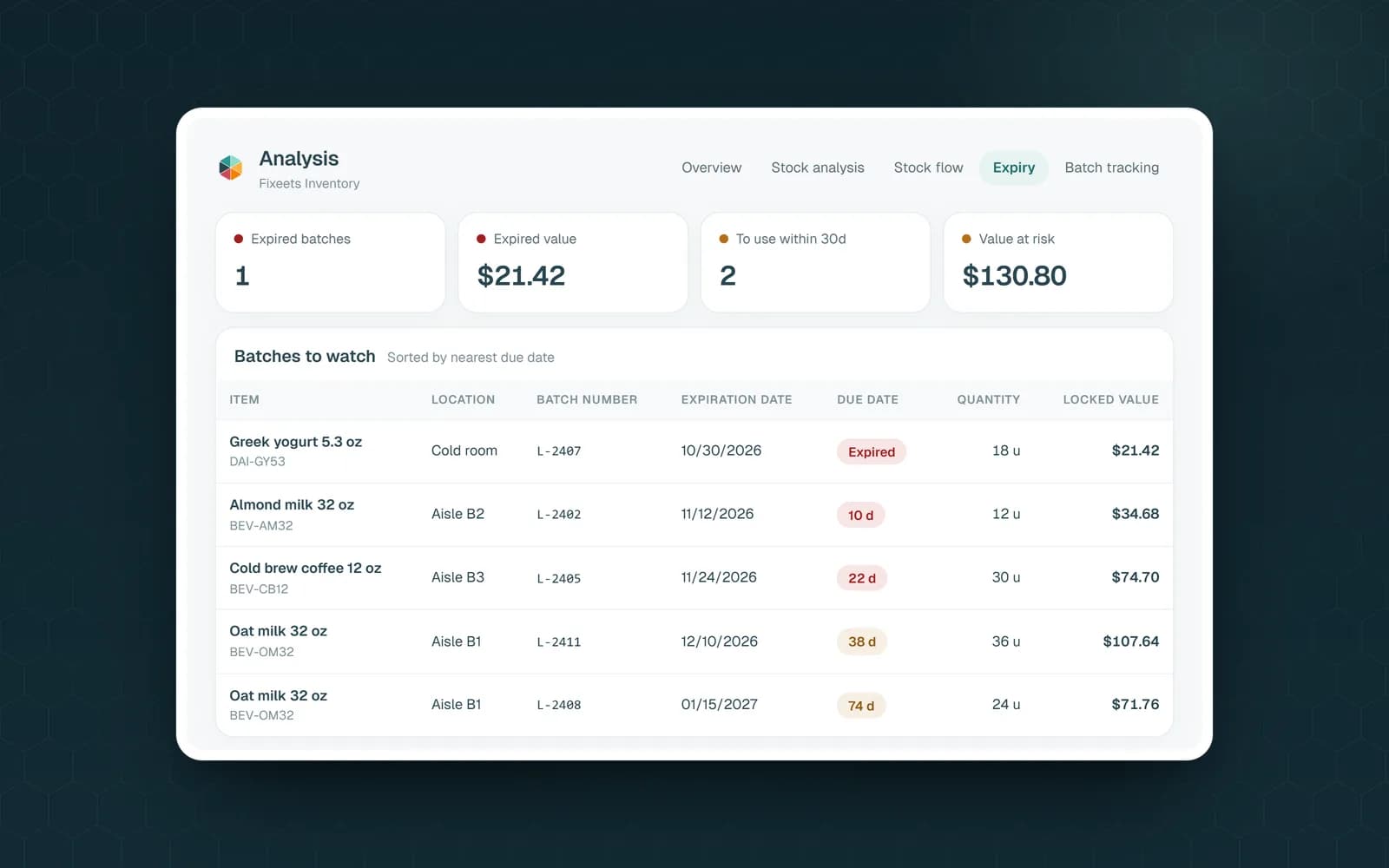
- The Expiry tab in Analytics groups batches by time left: expired, within 30 days, 30 to 90 days, more than 90 days. It shows how many batches and how much value are at risk, then lists the batches to watch, nearest date first, with location, batch number, quantity and days left. That is the weekly review, already sorted.
- The Batch tracking tab shows, for each batch, what was received, what went out and what is left, and flags batches where those numbers don't add up. Open a batch to see each of its entries and exits.
These two options are not reserved for a paid plan. What each plan includes is on the pricing page. If you are still choosing a method for the rest of your stock, our overview of inventory management methods compares FIFO, JIT and ABC analysis.
FEFO Rules to Remember
- FEFO: the batch with the nearest expiration date goes out first, whatever its arrival date
- FIFO and FEFO agree most of the time; FEFO wins when a later delivery has a shorter date
- Record the batch number and the expiration date at receiving, one line per batch
- Put the nearest date in front and write the picking rule down
- Record the batch on every exit, or the stock per batch drifts
- Once a week, review what expires soon and decide what to do with it