An equipment rental contract is the document that says who rents what, for how long, at what price, and who pays when something comes back late, damaged or not at all. For a small rental business, it is also the only thing you can point to when a customer disputes a deposit. A good one fits on two pages, uses the same wording every time, and is filled in from the booking instead of being typed again.
One note before the checklist: this is practical guidance from how rental businesses work, not legal advice. Rules on rentals, deposits and liability vary by state and by type of equipment, so have a lawyer review your standard terms once, then reuse them on every contract.
What an Equipment Rental Contract Has to Say
Most rental disputes come back to four questions: what exactly was handed over, in what condition, until when, and what the deposit covers. A contract that answers those four clearly avoids most arguments before they start.
In practice, a complete equipment rental agreement covers:
- The parties: the rental company and the renter, with contact details and, for individuals, the ID that was checked
- The equipment: each item with its reference or serial number, and its accessories
- The rental period: start date, planned return date and the number of days billed
- The price: daily rate, amount per line, taxes and total
- The deposit: amount, how it is held, and when it can be kept
- Insurance and responsibility during the rental
- Condition at checkout and at return
- Late returns and what they cost
- General rental terms on a separate page
- Signatures of both parties
The Parties, the Equipment and the Billed Period
The parties. Write the legal name of your business, its address, phone and email, then the same for the renter. For a company, the company name matters more than the name of the person picking up. For an individual, many rental businesses note that an ID was checked rather than keeping a copy they do not need.
The equipment. One line per item, with your internal reference and, for anything valuable, the serial number. "Concrete mixer" is not enough when you own three of them. "MX-40, concrete mixer, serial 4471" is. List the accessories too: chargers, blades, hoses, keys. Unlisted accessories are the ones nobody remembers at return.
The period and the price. State the start date, the planned return date and how many days are billed. Then say how a day is counted. If a customer picks up on Friday at 4 pm and returns on Monday at 9 am, is that two days, three, or a weekend rate? Whatever your rule is, write it down so the invoice matches the contract.
| Item | Daily rate | Days | Amount |
|---|---|---|---|
| MX-40 concrete mixer | $45 | 3 | $135 |
| GN-60 generator | $60 | 3 | $180 |
| Total | $315 | ||
| Deposit | $500 |
Deposit, Insurance and the Renter's Responsibility
The deposit. Give the amount, how it is held (card authorization, check, cash) and when it is returned. Then state when it can be kept, in a sentence the renter cannot misread: "The deposit may be retained in case of damage, loss or theft." If a repair can cost more than the deposit, say how the difference is billed.
Responsibility. The usual clause is short: "The rented equipment remains under the renter's full responsibility for the entire rental period." Add the use rules that matter for your equipment: who may operate it, where it may be used, and that it may not be sublet or lent.
Insurance. Decide which of two models you use. Either the renter declares that their own insurance covers the use of the equipment, or you offer a damage waiver for a fee. Write which one applies on each contract, because "I thought I was covered" is a common answer after an accident.
Condition at Checkout and at Return
This is the part people argue about most, so make it factual. At checkout, note the condition of each item: a scratch on the left panel, the hour meter at 1,240 hours, a full tank. Take a few dated photos from the same angles every time. Then have the renter acknowledge it: "The renter acknowledges receiving the equipment in the condition stated above."
At return, run the same checklist, ideally with the same person:
- Visible damage, photographed from the same angles as at checkout
- Hour meter or counter reading
- Fuel or battery level
- Accessories counted against the contract
- Cleanliness, if you charge for cleaning
Write the condition at return on the rental, then decide on the deposit right away. A deposit decided a week later is a deposit disputed. If a machine comes back with a fault, it should go straight into its service record: a clear maintenance history is what tells you whether a breakdown is new or has been building up over several rentals. If you plan servicing in a maintenance management tool such as Fixeets Maintenance, log the fault there the day the machine comes back. Before the machine goes back out, a maintenance work order tells the technician what to check, and tracking equipment maintenance in Google Sheets shows how to keep each machine's service dates in one place.
Late Returns and General Rental Terms
Late returns. Say what happens in one line: "Any late return may be charged at the current daily rate." Add how a renter extends a rental (a call before the planned return date, for example) and where and when equipment must be returned.
General rental terms. Keep the front page short and put the longer rules on a dedicated terms page attached to every contract: payment terms, cancellation, what to do if the equipment breaks down during the rental (call you, no repairs without your approval), and who handles disputes. Both parties sign and date the contract, and each keeps a copy.
Fill the Contract From the Booking, Not by Hand
The weak point of most rental contracts is not the wording. It is retyping. The customer, the items and the dates already exist in a calendar or a spreadsheet, and they get copied into a Word template by hand. That is where the wrong serial number, the wrong return date or the old deposit amount slips in.
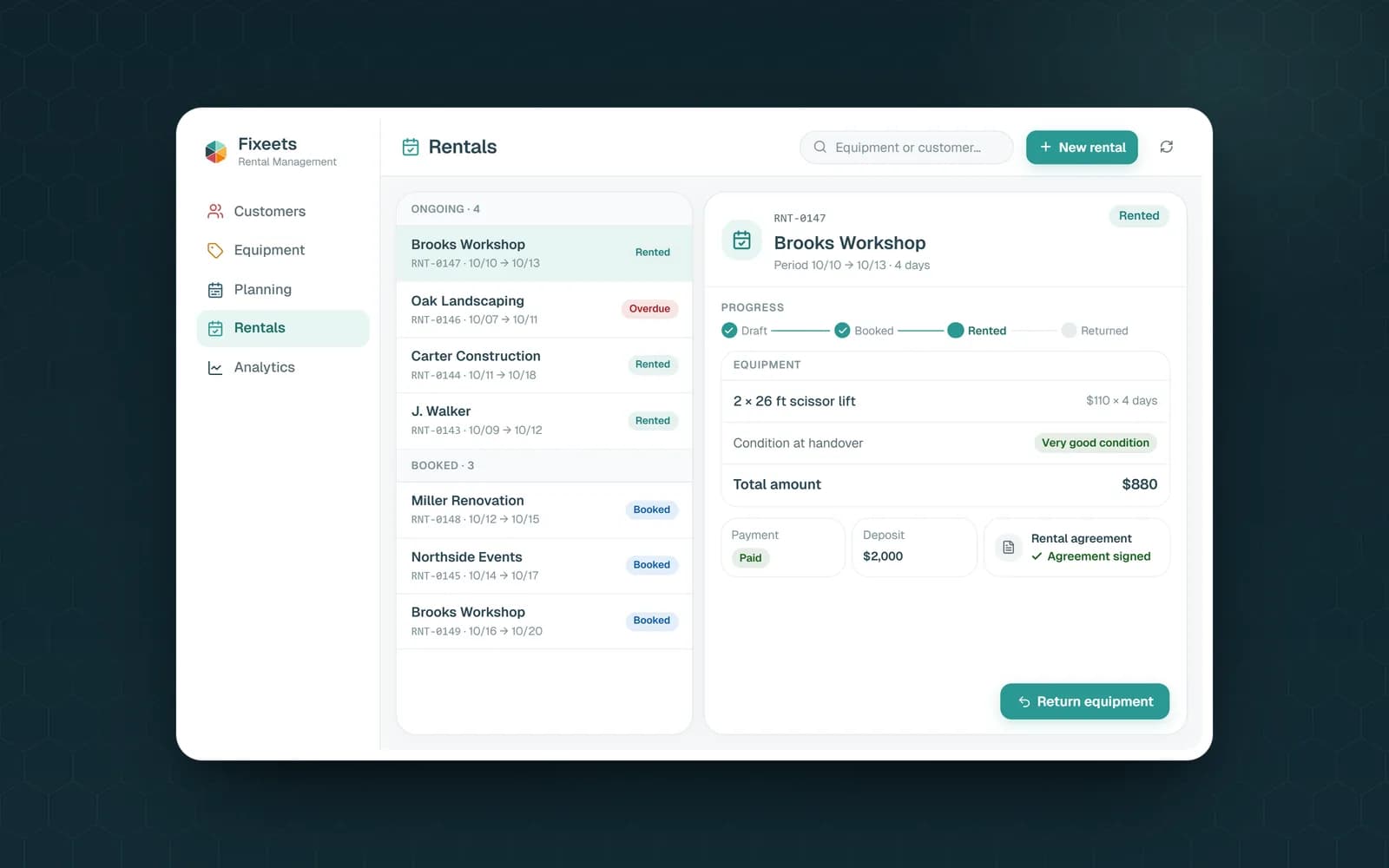
Fixeets Rental, our equipment rental management app that works with Google Sheets, builds the contract from the rental itself. You create the rental with an availability check on each item, and the PDF contract is filled in from it:
- Rental company and renter details, with the ID checked
- Each item with its condition at checkout, the rental dates and the days billed
- The amount per line, the total and the deposit
- Clauses you switch on or off: deposit retention, condition acknowledged, renter's responsibility, late return, renter's insurance
- A dedicated page for your own general rental terms, your logo and company stamp, and signature boxes for both parties
The PDF is saved to your Google Drive. At return, you note the condition of each item, and the deposit shows as received, refunded or withheld. You can start on the free plan; limits and paid plans are on the pricing page.
Equipment Rental Contract Checklist
Before a customer signs, check that the contract states:
- Your business and the renter, with contact details and the ID checked
- Every item with its reference, serial number and accessories
- Start date, planned return date and number of days billed
- Daily rate, amount per line, taxes and total
- Deposit amount, how it is held and when it can be kept
- Insurance: the renter's own cover or your damage waiver
- The renter's responsibility and the use rules
- Condition at checkout, acknowledged by the renter
- What a late return costs and how to extend
- A link to, or a page with, your general rental terms
- Signatures and dates from both parties